
Thailand
Bangkok
Koh Phangan
Koh Tao
Sukothai
Chiang Mai
Pai
Laos
Luang
Prabang
Vang Vien
Vientiane
Archive
Farewell
letter
Switchbacks zig-zagged our packed mini-bus up the mountains and utterly failed to deter our driver from passing slow pokes, honking his horn with vigor, as if it had special powers to shield us from any potential oncoming vehicle. Green in the gills, we arrived four hours later in Pai and plopped down at the first inviting place in town, a little restaurant and guesthouse called Abodaya. It had clean but nondescript rooms with, we soon discovered, a plywood-with-a-sheet-pulled-over-it-hard bed. Even Tomas felt bruised in the morning, so we decided to rent a motorbike and cruise the outskirts for more comfortable accommodations. Cheap and highly rustic bungalows on the banks of the Pai river failed to impress and promised to be mosquito magnets.
Finally, after squirreling our way around the countryside, we found “Pai-radise,” a lovely guesthouse with wooden bungalows, beds with a little give to them, matching sheet and fluffy comforter ensembles, and actual tiled bathrooms with separate shower stalls. Pin, the owner, baker, and furniture-maker of the place, welcomed us warmly, ushering us to beautiful bungalow #10. Our deck (yes, deck!) looked out over the spectacular Pai valley, and proved to be the perfect resting place in the afternoons. Each morning, Pin cooked us omelets served with homemade rolls, cheese, and slices of tomato. Not to mention fresh squeezed orange juice for me and dark, rich coffee for Tomas. Delicious!
We had a few monster-spider run-ins, though none of the beasts were quite as large as the one in Kho Phangan. On our first night, my laser, insect-focused vision spotted a huge sucker on the wall. Despite Tomas’ valiant efforts with the shoe, the spider eluded him with lightening speed, disappearing beneath our bed. Of course, then it was ON! We upended the mattress and chased it into a corner. Saying prayers for forgiveness to the Buddha, Tomas took him out with a swift flick of the wrist and we promptly flushed his remains down the toilet.
At this point, I could have gone one of two ways. There was no mosquito net. Clearly, spiders of that magnitude had no problem finding their way in. I could take the chance that one would crawl on my face in the middle of the night, or choose to believe that our recent encounter was a freak accident. One chance in a million that this kind of fuzzy, tarantula-esque beast would creep and crawl into our bungalow. It was time for my game face and a little dose of denial.
Alas, nature likes to assert its dominance whenever possible. The very next night, I was brushing my teeth at the sink, letting my eyes wander over the green tiles, around the dark wood framing the mirror, down the wall until I fixed my eyes straight ahead, perhaps attracted by the faint glow emanating from the tan hide of a gargantuan spider not two inches from my nose. Even as I screamed, dropped my toothbrush, and leapt out of the bathroom in nanoseconds, I registered how strange it was that these spiders kept wandering into my vision and not my husband’s. This time, I pushed Tomas into the bathroom and shut the door behind me. After some banging, periods of silent strategizing, and the final removal of the mirror (under which the spider scampered after Tomas’ first near-hit), the target was finally eliminated. I grit my teeth, looked around our otherwise luxurious room, and politely entreated the spiders to find another squeamish person to torment. To my relief, they acquiesced and we enjoyed another week at Pai-radise without incident.
Spiders and all, Pai was one of the most beautiful places I’d ever been. The town itself was a quaint, friendly place that reminded us a little of Bolinas, in Marin. The countryside, however, defies comparison. Green rolling hills with a patchwork of banana trees, rice paddies, and forests bleed into tall, rugged mountains with jungle terrain. Most of the roads in the Pai valley were paved lanes, barely wide enough for a car. On our motorbikes (I soon felt confident enough to ride my own), we covered much of the valley, in awe of each new vista as we rounded the hillsides. Friendly Thais from the small villages sprawling out from the side of the road waved at us as we motored by, the children yelling, “Hello! Hello!” Many of the houses were made of teak, a beautiful, richly dark wood that glows in the sun.
One day, in search of a particular waterfall, we ventured down a deeply rutted road that suspiciously resembled a dry riverbed. We would have been better served with dirt bikes. However, after my first and only motorcycle spill (absolutely no harm done), I dusted off the red dirt from hands and bottom and managed to poke my way behind Tomas. By the time we arrived, some young travelers were already considering how they might “ride” the waterfall. Finally, a particularly daring fellow stripped down and jumped into a pool about half way down the fall. He then scooped up water to wet the stone down the bottom half of the fall. Once satisfied, he sat down on the edge and pushed off with both hands. Before we knew it, he was sliding down the side of the fall and plunging into another pool at the bottom. We later learned that this landing pad was only about six inches deep and provided a jaw-jarring end to the otherwise painless ride down. Emboldened by the demonstration of machismo, several of the other youths followed suit. Tomas and I decided that passing the thirty year mark gave us each a “Pass GO Free” card.
Other Pai entertainment included feeding elephants parked at the side of the roads at elephant ride outfits. There’s nothing like grabbing a handful of snorting, wet elephant trunk and sliding one’s fingers along an elephant’s leathery, prickly hide. Through the grapevine, we heard about a nighttime elephant show and decided to pop in for a look. At first it appeared that the entire show consisted of elephants extracting money from the group of Thai children, their parents, and farangi in a garbage-laden, scruffy field just off the night market in town. We dutifully put coins and small bills in our palms while baby elephants gently pinched them with their surprisingly agile trunks and delivered them to the “drivers” sitting on their heads. After about an hour, as we were running low on small coinage, we decided to head out. Just then, a line started forming at the edge of the field and before we knew it, we were ushered into another sectioned-off area and watching elephants kick oversized soccer balls to each other and compete at bocce ball.
Another Pai mainstay is trekking to the hilltribes. We stumbled upon a recommendation for a guide while surfing the net one day and decided to check him out. Pat, from the Duang Guesthouse, turned out to be a gem, and we joined him for a two-day trek through the mountains to visit Lahu, Lisu, and Karen hilltribe villages. We hiked for ten kilometers a day through rice patties, rain forests, tropical jungles, and many, many rivers. The muddy, jungle mountainsides we scaled were so steep that if they were any more vertical, we would have needed rope. It was tough work!
After our first day, we stopped for the night in a Lahu village, which we approached from a packed-dirt lane lined with wooden fences and dainty, blue flowering bushes. We could have been in the Shire, if, in the pink glow of sunset, we spied round thatched hobbit roofs instead of the square ones of the Lahu tribe. The village itself was quite new, only seven years old. Previously on a different mountaintop, the village moved when the medicine man deemed the old village unfit. People were dying in droves and despite the man’s magic, they continued to die. He came to believe that the location itself was cursed and advised abandonment. Later, a government doctor revealed that the cause of death was not malevolent spirits, but rather a bad case of malaria.
We ate and slept in the home of Pat’s friends, one of the nicer looking huts in the village. All of the huts were built on stilts (an architectural practice employed throughout Southeast Asia) and composed primarily of bamboo. Shafts split in half and threaded side-by-side made up the floor, which creaked and rattled with every step. The sides of the hut were made of strips of woven bamboo. House wares were also made of bamboo. To form cups, the villagers had cut bamboo stalks just below their knots, which formed a natural cup bottom, and then about three inches above the knots, forming the lip.
It’s no wonder that bamboo is a well-used resource. It grows in clumps aplenty throughout the mountains at a rate of fifteen feet a month! That’s six inches a day! A quarter of an inch an hour! An efficient plant, it heads straight to the sun for a while, not bearing any foliage or veering left or right until it’s well-nourished. Only then will it sprout thin, pea-green leaves and bend like a strung bow.
The hilltribe peoples rigged kitchens inside, which were basically fires with platforms suspended over them that dispersed smoke, which then easily escaped through the porous thatched roof, and housed pots, pans, herbs, and other cooking utensils. Underneath the house, pigs, chickens, dogs, and kids tried to edge each other out for turf. The WC was a smaller, dirt-floor hut behind our host’s home measuring about four feet wide, five feet long, and six feet high. It was less lovingly constructed, it seemed; I could easily watch the children at play outside through the large gaps in the slats. The shower was a small scoop in a large plastic bucket full of ice-cold water. Douse, lather, douse again…while squatting. I loved it! Nothing like a rough ten-kilometer hike followed by a numbing bucket-bath to make one feel like an adventurer!
Sleeping did pose some problems. The bamboo floor was hard. The pigs were loud. The dark was pitch. And something that felt like a large rat crawled several times over my legs. Stiff with dread and terror, I pulled my sleeping bag over my head, ignoring the fact that I could hardly breathe, and was half-awake all night long, half expecting Mr. Rat to poke his nose down my bag, scuttle his scrawny little feet on my head, and slither his long, sickening tail down the length of my face. The next morning, weary from my sleepless battle with the phantom rat-on-my-mind, I watched the oh-so-cute kitten playing with my fellow trekkers and slowly it dawned on me that my fiendish foe was none other than this same kitten, purring and frolicking as if it hadn’t a care in the world.
Stepping out into the sun, Tomas and I were delighted to watch the training BMIT (Big Man in Tribe) practice his arts. This tiny kid, probably no more than six years old, squatted around his own miniature fire, which he had proudly made and continued to stoke, all while chattering incessantly to his rapt, even younger crew. We were also delighted to see the village elder wearing a “Miss Oklahoma Pageant 2000” T-shirt.
The only real downside of our trek was the brutal ride to and from our starting/ending point. Traveling over bone-jarring, teeth-rattling, bumpy roads, eight people—plus supplies—squeezed into the bed of a mini-pickup truck for an hour and a half. On the way up, I was lucky enough to sit in the front of the truck and witness first hand our near-accident head-to-heads with spinning out motorcycles. On the way back, I declined the front seat (lessons learned from Survivor that too much of a good thing will put you in bad standing with the tribe) and got a good dose of the torturous ride. About half way through, Tomas and I stood up and rode the truck like charioteers, holding onto the roof for dear life.
As if our time in Pai wasn’t heavenly enough, we topped it off by taking a cooking class from Thom, at Wok and Roll, who regularly quoted raunchy American movies and called us all “honey,” “baby,” and “sweetie” in a thick Thai accent. Thom was no-nonsense when it came to educating her students. She took us to the market and pummeled us with the basics of Thai cooking: chilies, lemon grass, galanga, shallots, and garlic. We made curry paste from scratch using a mortar and pestle and stirred up pad thai for lunch. After an afternoon rest to digest, we whipped together tom yum kai (coconut soup with chicken), tom kha kai (spicy chicken soup), paneang curry, and red curry for dinner. The beautiful thing about Thai curries, we learned, is that with one homemade red curry paste, you can add a few extra ingredients to render it into paneang curry, yellow curry, or tumeric curry, each with its own distinctive, delicious flavor.
Thom not only taught us the basics of Thai cooking, she also regaled us with stories of her irreverence to local authorities: switching signs to avoid “big sign” taxes, lying to police about helping Burmese refugees (a no-no, apparently), hiding the landlady’s chicken eggs and claiming ignorance to their whereabouts, you get the picture. With a kiss, a hug, and a “baby, honey, sweetie,” she sent us off with our recipe books and good wishes. After LOTS of good food, plenty of adventure, and somewhat battered bodies from our trek, we reluctantly pried ourselves away from Pai and set our sights on Laos.
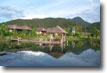
Pairadise Lagoon

Pai Deckview
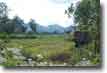
Pai Countryside
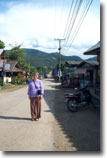
Downtown Pai

Mainstreet Pai, Rush Hour
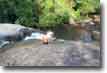
Pai Waterslide

Elephant Show
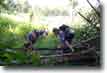
Lucy Trekkin'

Pai Country Lane
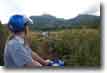
Lucy on a Motorcycle!?

Roadside Wat in Pai

Arriving at Lahu Village
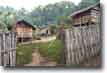
Lahu Village
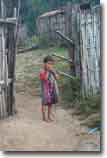
Welcoming Committee
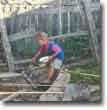
Little BMIT
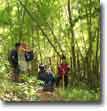
Shh, Hear it Growing?
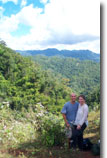
Tired Trekkers
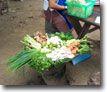
Makings of a Feast
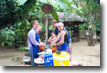
Get Cookin'

Feeding Time